What a pharmacy pays for these drugs
Pharmacies acquire Zepbound at roughly $482 a month, while Lilly sells it direct for $449. Phentermine costs a pharmacy $2.18 a month, and subscriptions charge thirty to fifty times more for it. Those are CMS's figures: its NADAC survey publishes what pharmacies paid, weekly, by product, for free, beside the prices comparison sites publish.
Last updated 2026-10-05 — the NADAC file this table was built from. Read and dated by Alex Seot.
What does a pharmacy actually pay for a GLP-1?
Under the federal NADAC survey — what pharmacies report paying — a month of Zepbound costs a pharmacy about $482, Wegovy about $1,306, and generic phentermine $2.18. Those are higher than what the manufacturers charge patients directly: Lilly sells Zepbound self-pay at $449 and Novo sells Wegovy at $349, both below what a pharmacy pays to stock the same product. That inversion is not a discount, it is two markets: the pharmacy channel buys against a list price that rebates are negotiated off, while the direct channel has no intermediary to pay. The consequence is that routing a prescription through insurance can cost more than ignoring it, because a deductible or a coinsurance share is calculated from that same list price. For the old orals the reading differs: phentermine is a solved manufacturing problem at seven cents a tablet, so a $99 subscription sells access to a prescriber, not medicine.
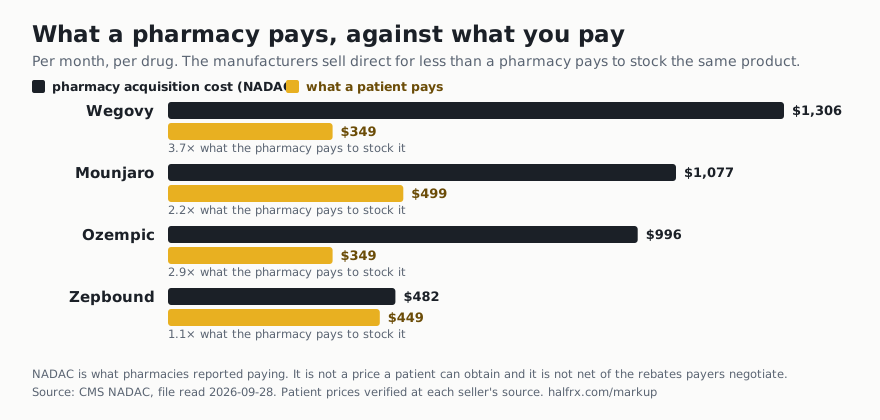
<img src="https://halfrx.com/chart/pharmacy-markup.svg" alt="What a pharmacy pays for each GLP-1 against what a patient pays"> It redraws itself when the weekly NADAC file lands, so an embed cannot go stale without the chart saying so.- Wegovy (semaglutide injection)$1,306 pharmacy pays · $349 you pay
- Mounjaro (tirzepatide, diabetes label)$1,077 pharmacy pays · $499 you payoff-label for weight
- Ozempic (semaglutide, diabetes label)$996 pharmacy pays · $349 you payoff-label for weight
- Zepbound (tirzepatide)$482 pharmacy pays · $449 you paypatient price checked 2026-08-19, past the 45-day window
| Drug | Pharmacy pays | You pay | The arithmetic |
|---|---|---|---|
| Saxenda (liraglutide) | $1,307/mo | no verified price | 3 mg a day is 0.5 mL, so 15 mL a month — 15 mL at $87.13 per mLeff. 2026-09-23 |
| Wegovy (semaglutide injection) | $1,306/mo | $349/mo3.7× under acquisitionverified 2026-09-22 | four single-dose pens of 0.5 mL a month — 4 × 0.5 mL at $653.04 per mLeff. 2026-09-23 |
| Mounjaro (tirzepatide, diabetes label) | $1,077/mo | $499/mo2.2× under acquisitionverified 2026-09-21off-label for weight | four single-dose pens of 0.5 mL a month — 4 × 0.5 mL at $538.52 per mLeff. 2026-09-23 |
| Ozempic (semaglutide, diabetes label) | $996/mo | $349/mo2.9× under acquisitionverified 2026-09-22off-label for weight | one 3 mL pen a month at the 0.25–0.5 mg doses — 3 mL at $331.99 per mLeff. 2026-09-23 |
| Zepbound (tirzepatide) | $482/mo | $449/mo1.1× under acquisitionchecked 2026-08-19, past the 45-day window | four weekly doses a month — one 2.4 mL KwikPen holding four doses at $200.92 per mLeff. 2026-09-23 |
| Phentermine (generic) | $2/mo | no verified price | one 37.5 mg tablet a day — 30 × $0.0727eff. 2026-09-23 |
Why is the manufacturer's price lower than the pharmacy's?
- For the branded injections, the manufacturer's own cash price beats the pharmacy channel. That is not a discount; it is a different market. It also means “go through your insurance” is worth checking rather than assuming, because a deductible or a coinsurance share is calculated off the list price the acquisition cost sits near.
- For the old orals, the drug is nearly free and the price is the prescriber. Phentermine at $2.18 a month is a solved manufacturing problem. Anything charged above that is access, not medicine — which is fine, as long as it is priced as what it is.
- Compounded GLP-1s have no NADAC row at all, because they are not FDA-approved products with an NDC in the survey. There is no public cost floor to compare them against, which is worth remembering when one is sold as the cheap option.
Questions
- What is NADAC?
- The National Average Drug Acquisition Cost — a survey CMS runs of what retail pharmacies actually paid for a drug, published weekly by NDC as an open file. It is the cost side of a transaction whose price side is everywhere. It is not a price you can walk in and pay: a pharmacy that bought at NADAC still has to dispense, stock and staff, and the number carries no rebate.
- Why is the manufacturer's own cash price lower than what pharmacies pay?
- Because they are two different channels. The list price a pharmacy buys against is the number rebates are negotiated off — the manufacturer discounts it privately to pharmacy benefit managers, and the pharmacy's acquisition cost sits near the top of it. The direct-to-patient price is set by the manufacturer with no intermediary to pay. That is why LillyDirect sells Zepbound for less than a pharmacy pays to stock it, and why routing the same prescription through insurance can cost you more than ignoring your insurance entirely.
- So should I stop using my insurance?
- Sometimes, and it is worth checking rather than assuming. If your plan covers the drug with a low copay, use it. If it applies a deductible, a coinsurance percentage or refuses the obesity indication, compare that against the manufacturer's cash price before filling — the cash route also does not touch your deductible, which cuts both ways. Manufacturer copay cards cannot be used with Medicare or Medicaid at all.
- Does a cheap acquisition cost mean the drug should be cheap?
- For a generic, largely yes — phentermine at $0.07 a tablet is a solved manufacturing problem, and a $99 monthly subscription for it is selling access to a prescriber, not a medicine. For the branded GLP-1s the acquisition cost is high because the list price is high, and that is a patent and pricing question rather than a manufacturing one — semaglutide's compound patent expired in March 2026 and fifteen further patents on Ozempic run to 2041, which is why no generic has followed. The listed dates are on /generic.
Source: NADAC (National Average Drug Acquisition Cost), CMS, file read 2026-10-05. Acquisition cost is not a price available to a patient and is not net of the rebates payers negotiate; it is the cost side of the same transaction, published. Prices on the right are the verified figures from each drug's own price page, and “from” marks the lowest published price where no maintenance price is published.